
When Moonlight won the Academy Award for Best Picture in 2017, it was a sensation for two reasons. First, it pulled off a last-second upset over the presumed favorite La La Land in a race so chaotic that the wrong winner was briefly announced on stage. Second, its victory marked a watershed moment for A24, the once-upstart indie studio that had forced its way into an awards ecosystem long dominated by major Hollywood players and their prestige labels.
Clair Obscur: Expedition 33’s triumph at Thursday’s Game Awards was far less theatrical. It entered the night as the overwhelming favorite and performed exactly as expected, taking home Game of the Year alongside eight other awards. But in industry terms, its victory may be just as significant as Moonlight’s—if not more so.
The game has been locked in as the Game of the Year frontrunner for so long—essentially since its April release—that it’s easy to overlook how unlikely this outcome once seemed. At the start of the year, Clair Obscur was barely on the wider industry radar, as expectations centered on Grand Theft Auto 6 sweeping the awards conversation before Rockstar’s blockbuster was pushed to 2026.
Its win is historic on multiple fronts. Clair Obscur is the first title in The Game Awards’ history to cross over from the indie categories—where it also claimed top honors—to win Game of the Year outright. It marks the debut release of French developer Sandfall Interactive. And its publisher, Kepler Interactive, was formed just four years ago as a cooperative venture between seven small independent studios.
Like A24 in 2017, Kepler represents a new kind of outsider—one proving that prestige, scale, and cultural impact no longer belong exclusively to the industry’s biggest players.
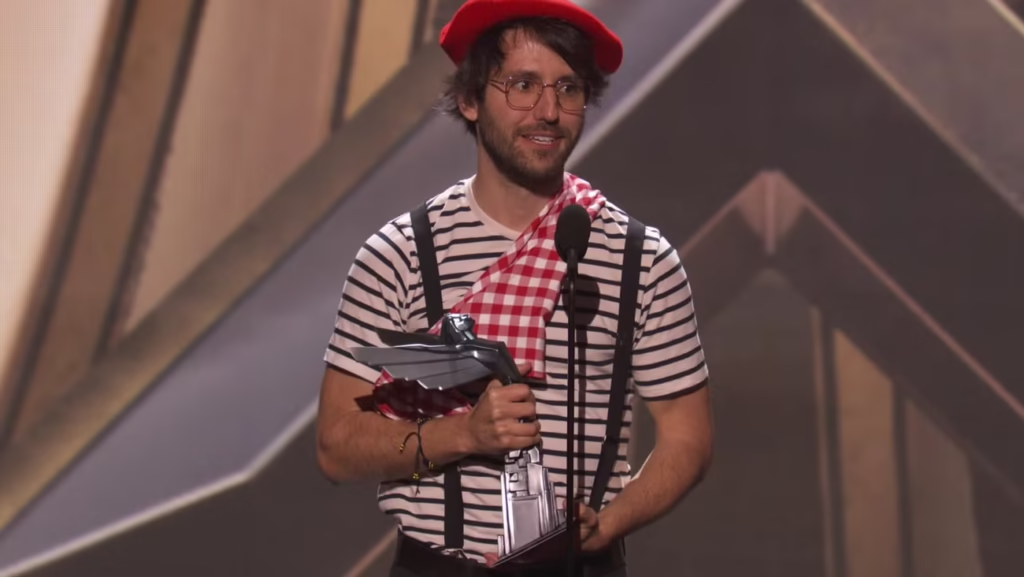
Guillaume Broche accepts the Game of the Year award at The Game Awards 2025.
Yet the steamrolling Sandfall Interactive and Kepler engineered this year was less reminiscent of Moonlight’s shock victory than of A24’s second Best Picture sweep with Everything Everywhere All at Once, or Christopher Nolan’s Oppenheimer dominating the Oscars in 2023. The sheer scale of Clair Obscur’s success is unprecedented—and not fully captured by the trivia-friendly fact that it surpassed The Last of Us Part II’s previous record of seven wins by two.
Its dominance was so complete that no other game managed more than a single award. Nintendo was the only publisher besides Kepler to leave the ceremony with multiple wins, taking home two. Sony, the most successful publisher in Game Awards history and the night’s nomination leader with 19, walked away empty-handed—unless one counts HBO’s The Last of Us season 2 winning Best Adaptation. The same was true for Hideo Kojima, whose Death Stranding 2 entered the night with seven nominations and left without a trophy.
There is, quite simply, no true precedent for Clair Obscur’s performance. The closest comparison is Baldur’s Gate 3, a fan-favorite role-playing game that built unstoppable momentum toward a Game of the Year win few would have predicted at the start of 2023. But even that parallel only goes so far. Baldur’s Gate 3 was technically self-published by Larian Studios, yet developed with the backing of Dungeons & Dragons license holder Hasbro. It also wasn’t nominated in the indie categories, and it was a sequel from a well-established—if not exactly mainstream—studio.
Clair Obscur achieved a level of dominance at the Game Awards, and in the broader conversation around the year’s best games, that was previously reserved for giants like Naughty Dog or Rockstar Games. That a debut title from an unheralded studio could reach such heights is remarkable—and deeply encouraging for the long-term health of the game industry.
It’s also telling that, to the extent Clair Obscur faced meaningful competition at all, it came as much from acclaimed indie releases like Hades 2 and Hollow Knight: Silksong as from Sony and Nintendo’s marquee titles. Prestige, it seems, is no longer the sole domain of scale.

The indie takevoer of 2025’s Game of the Year nominees — which included Hollow Knight: Silksong — might be a one-off.
So does Clair Obscur’s sweep herald a new era, in the way Moonlight once did for the Oscars? Will this mark the beginning of a different kind of Game of the Year winner? Maybe—but maybe not.
Without diminishing Sandfall Interactive and Kepler’s remarkable achievement, a fuller look at the context surrounding Clair Obscur’s wins complicates the narrative. 2025 was an unusually quiet year for blockbuster releases, with publishers either steering clear of what they expected to be Grand Theft Auto 6’s launch window or grappling with the ballooning production timelines that now define AAA development. That absence created space for something unexpected to break through.
The clustering of indie contenders was also something of an anomaly. This year, half of the six Game of the Year nominees were also shortlisted for Best Independent Game—a crossover that, in past years, rarely involved more than a single title. Hades 2 and Hollow Knight: Silksong were both highly anticipated sequels to beloved indie hits, released within weeks of each other—a convergence that may be more once-in-a-generation than a sign of a lasting shift.
Look beyond those two games and Clair Obscur, and the broader trend reasserts itself. Despite the headlines, The Game Awards’ large, international jury is actually nominating fewer indie titles across fewer categories than it did a decade ago. Clair Obscur may represent a breakthrough—but it may also be the exception that proves the rule.
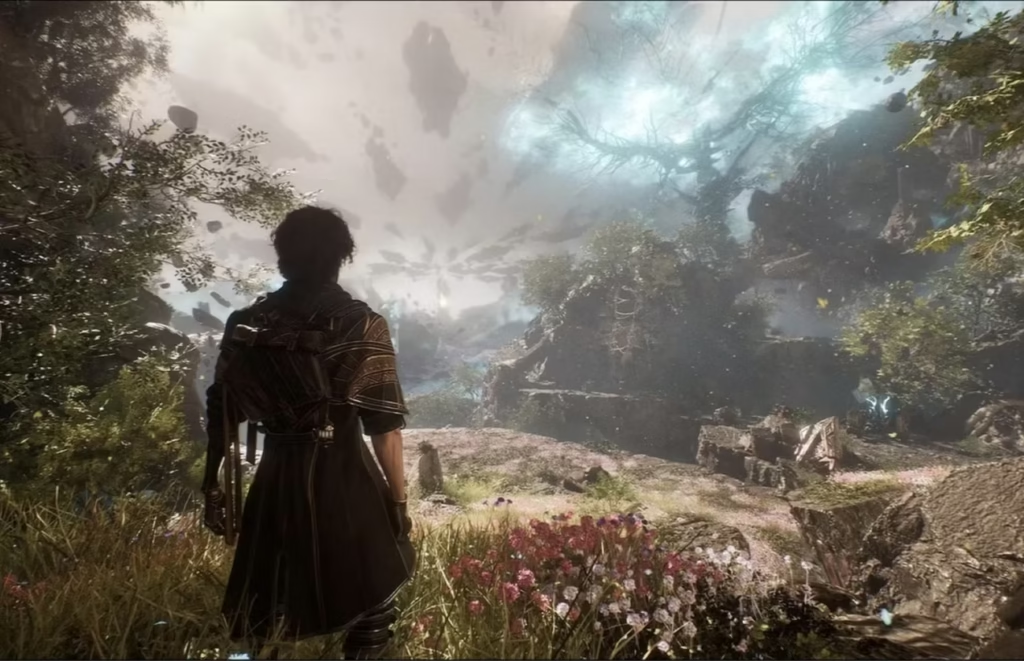
Clair Obscur is, in many ways, a far more traditional Game of the Year winner than its outsider narrative suggests. Its appeal lies partly in its distinctive fusion of culturally French influences with classic, turn-based Japanese role-playing design. But it is also a substantial adventure with high production values, an expansive fantasy setting, a sweeping narrative, and cinematic presentation and performances—precisely the sort of accessible, prestige-friendly package The Game Awards jury has historically favored. It’s an excellent game, but it is not a radical stylistic frontier for the medium.
What Clair Obscur’s emphatic Game of the Year victory does demonstrate is something arguably more important: that a smaller team, with fewer resources and without the backing of the industry’s traditional power centers, can now produce a game that rivals major publishers on both scope and quality—and connect with players at scale. It shows that a publisher like Kepler, and a debut developer like Sandfall Interactive, can effectively stage a hostile takeover of gaming’s middle ground, delivering the kinds of experiences players want at a lower cost, both to the studios making them and the audiences buying them.
That possibility matters at a moment when the industry is buckling under the escalating, increasingly unsustainable costs of blockbuster development. Next year’s Game of the Year will likely belong to exactly that kind of mega-production: Grand Theft Auto 6. But that outcome depends on the game actually arriving—something that, given the sheer enormity of its development, remains far from guaranteed.
If it doesn’t, there may be another Clair Obscur. Another Sandfall. Another Kepler. Ready to step into the gap.